Tunnels
Pre- and post-excavation grouting
Ground that is grouted before it is dug is still confined, and the water has not yet found its way in. Ahead of the face we build a grouted canopy and consolidate the core; behind it we fill the voids and close the water paths the excavation opened.
When to call us
The signs
- Probe holes ahead of the face release water.
- Rock with closely spaced joints, clay infill or a very low Q value at the face.
- Fault and shear zones, or running ground, that will not stand long enough to support.
- Shafts and cross-passages through water-bearing soil.
- Voids and water paths left behind the primary support or the lining.
- 1Note 1: Probe holes ahead of the face find the water and the weak ground before the crew does.
- 2Note 2: Perforated self-drilling anchors drilled in a fan from the face, above the tunnel profile.
- 3Note 3: Resin injected in stages, outer holes first, at controlled pressure.
- 4Note 4: The holes overlap into a grouted canopy over the profile, with the water cut off.
- 5Note 5: Face bolts and resin consolidate the core so the face stands.
- 6Note 6: Excavate under the canopy, then drill the next fan with an overlap.
- 7Note 7: Check holes and inflow readings before each advance.
How we do it
Method, step by step
Probe
Probe holes and the geology at the face show where the water and the weak ground are.
Design the canopy
Hole pattern, length, angle and overlap set for the ground; stages and pressures defined before drilling.
Drill
Perforated self-drilling anchors in a fan above the profile, and face holes into the core.
Inject
Resin in stages, outer holes first, at controlled pressure. The grout spreads along each perforated bar, not from one point.
Check and advance
Check holes and inflow readings before excavating under the canopy, then the next fan with an overlap.
Grout behind the face
Contact and void grouting behind the support closes what the excavation opened.
What we use
Made at our plant in Alwar
DrucHyd 2C (aqueonglobal.com, opens in a new tab)
Curtain grouting against active inflow; waterproofing and consolidation under water pressure.
PuTeRA (aqueonglobal.com, opens in a new tab)
Water stopping, void filling, ground reinforcement, slab and track lifting.
DrucPietra (aqueonglobal.com, opens in a new tab)
Low-foaming resin for deep curtain grouting and rock consolidation.
GeoFine (aqueonglobal.com, opens in a new tab)
Rock and soil injection where a cementitious grout is specified.
Quality
Checks and proof
- Probe and check holes at every stage, with inflow recorded at the face.
- Staged injection with pressure and volume logged per hole and refusal criteria set in advance.
- Acceptance value for the face agreed before the next advance.
On record
Where we have done it
Delhi Metro CC-04, Azadpur
Two tunnel boring machines held 30 m down in loose, saturated sand. We sealed and consolidated the ground so they could be retrieved.
T-49B escape tunnel, Arpinchala, USBRL
Cavities in a Himalayan escape tunnel treated with low-foaming and water-reactive PU resins: one of the two largest chemical grouting jobs we have held.
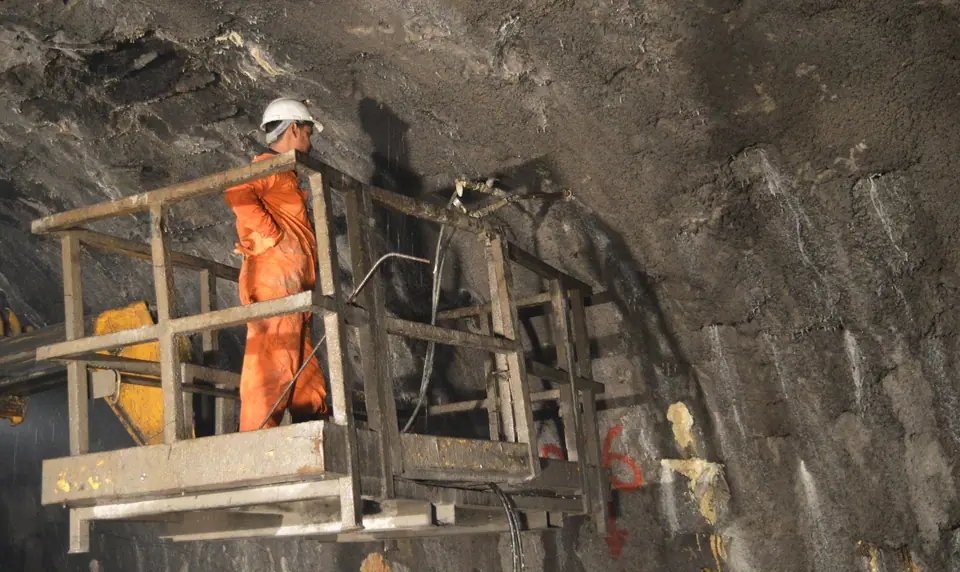
USBRL tunnels T-1, T-3 and T-5, Katra
Heavy water ingress in Himalayan tunnels, controlled with our resin, grout design and crews: recorded by Northern Railway at up to 2,500 litres per minute.
Questions
What clients ask
Why grout before excavating rather than after?
Before excavation the ground is still confined and the water has not yet opened its paths. Treating it afterwards means working against inflow and loosened ground, which takes more material, more time and more risk.
What is a grouted canopy, or umbrella?
A fan of overlapping grouted holes drilled from the face above the tunnel profile. Once grouted, it forms an arch of treated ground, and the next length is excavated beneath it.
Why self-drilling anchors?
In broken ground a drilled hole collapses before a bar can be put into it. A hollow self-drilling bar drills the hole and stays in it, and perforations along the bar spread the grout along its whole length.
Related services
Often used together
Tunnel water ingress control
Leaks and inflow stopped in tunnels, shafts and underground structures.
Cavity and void filling
Voids above tunnel crowns, behind linings and under slabs filled without loading the support.
Rock bolting and self-drilling anchors
Rock bolts, self-drilling and prestressed anchors for tunnels, portals, slopes and caverns.
Permeation and chemical grouting
Weak, loose or wet ground strengthened and sealed by resins and gels that fill it without moving it.
Seeing this on your site?
Send us what you see, where, and the access or traffic window. An engineer reviews it and replies with the next step.