Railways · KRCL for Northern Railway · 2025–26
T-46 P2, Sangaldan, USBRL
Ballastless track that settled further every monsoon, lifted back to its design profile on a live line, with the ground beneath made stable.
Grouting and ground engineering · railways · tunnels · dams · mines
Settled track, wet tunnels, weak formation. We find the cause below, design the treatment and inject it inside the traffic block, with grouts and resins made at our own plant in Alwar.
Certified Konkan Railway, February 2026: settled slab track at T-46 P2 on the USBRL lifted back to its design profile on a live line, by up to 136 mm.
Largest lift, on the most settled slab.
Residual settlement, measured after traffic resumed.
Traffic blocks beyond the planned night blocks.
T-46 P2, Sangaldan, USBRL. Read the case study
Tunnels served and secured
Projects successfully executed
Field engineers
Research papers and presentations
Start with the problem
Pick the nearest one. You will see how we would treat it, and where we have done it before.
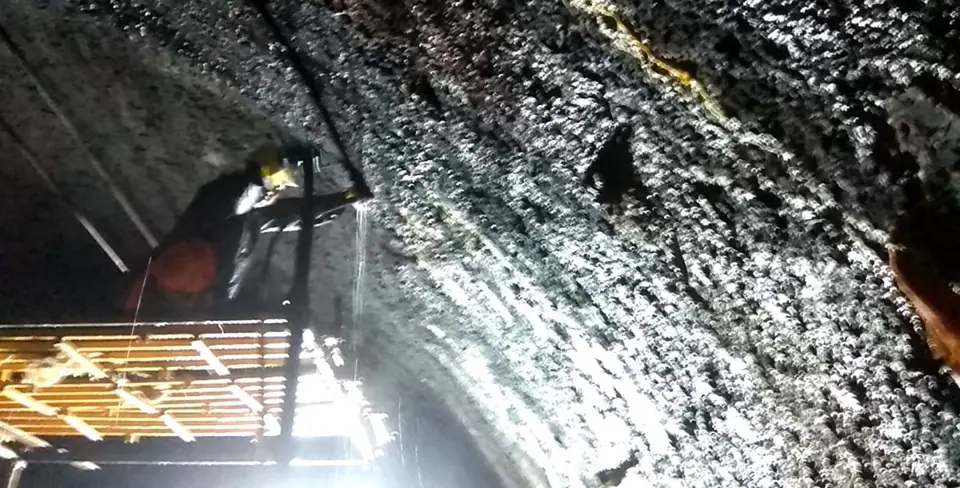
We map the leaks, drill through the lining and inject a water-reactive PU that expands into the joints behind it, cutting the water off before it reaches the lining. The tunnel stays in use.
Done before
2,500 L/minSeepage controlled in USBRL tunnels near Katra, recorded by Northern Railway in 2016.
See the project →PU injected under the slab lifts it in small steps inside the traffic block. Then the formation is grouted and the water cut off, so the next monsoon does not undo the work.
Done before
136 mmLargest lift on T-46 P2, Sangaldan, with 0 mm residual settlement. Certified by KRCL.
See the project →Pipes or self-drilling anchors through the support carry high-foaming PU into the void. It fills from the bottom up, binds the loose material and cures light.
Done before
T-49BCavity treatment with PU in the USBRL escape tunnel at Arpinchala, for Afcons.
See the project →A fan of perforated self-drilling anchors from the face, injected in stages, forms a grouted arch over the profile and consolidates the core. Excavate under it, then repeat with an overlap.
Done before
2 TBMsFreed from loose, saturated sand 30 m below Delhi, after we sealed and consolidated the ground.
See the project →A grout curtain across the flow, and consolidation grouting under the base, with the grout chosen for the water: cement where the rock is open, resin where the water is moving.
Done before
Up to 85%Seawater ingress into a micro-tunnel pit at Pipavav, cut by up to 85 per cent with grouting. Certified 2013.
See the project →Soil nails and self-drilling anchors, mesh or shotcrete on the face, drainage to take the water pressure out, and a barrier above the line.
Done before
52 daysAhead of the contract date: slope restoration by PU and cement grouting on Western Railway’s Godhra–Ratlam section. Certified 2024.
See the project →Self-drilling anchors from outside the footprint and chemical grout consolidate the soil under the footings, while the building stays in use.
Done before
22×Strength of treated site soil in IIT Patna’s tests for the Badi Patan Devi heritage site.
See the project →Packers drilled to cross the crack inside the wall. PU or acrylate gel where water is moving; epoxy where the crack must be bonded.
Done before
ParsikSeepage controlled through a century-old masonry arch, under live traffic, in Mumbai.
See the project →One party, one accountability
Most firms in this field either sell chemicals they do not apply, or apply someone else’s chemicals to someone else’s design. We formulate and make our resins at Alwar, own the injection plant and send our own crews. If a result is not achieved, there is no argument about whose fault it is.
Our ISO certificates cover manufacturing and application together: polyurethane injection grouts, coatings, polyureas, epoxies and foams, with design and application.
| Chemical supplier | Applicator | Geo Constech | |
|---|---|---|---|
| Makes the grout | Yes | No | Yes |
| Adjusts it to your ground and water | No | No | Yes |
| Designs the injection | Yes | No | Yes |
| Owns the injection plant | No | No | Yes |
| Sends its own trained crews | No | Yes | Yes |
| Answers for the result | No | Partly | Yes |
Recent work
Railways · KRCL for Northern Railway · 2025–26
Ballastless track that settled further every monsoon, lifted back to its design profile on a live line, with the ground beneath made stable.

Where we work
Usually on a structure that has to stay in use while we work: a running line, an operating tunnel, a dam in service, a working mine.
Settled track, transition zones and wet tunnels on running lines.
Railways →Water, cavities and weak ground in tunnels, shafts and metro works.
Tunnels and metro →Seepage, foundations, tunnels and slopes on hydro projects.
Hydropower and dams →Water in shafts and declines, and weak strata at faces and in roadways.
Mining →Water tunnels and shafts, micro tunnels, pipelines, manholes and highway slopes.
Water, ports and highways →Settlement, cracks and leaks in heritage structures and buildings in use.
Heritage and buildings →On the map
A selection of 22 jobs in 14 areas: USBRL tunnels in Jammu and Kashmir, a heritage site in Patna, dams in Meghalaya, rail tunnels in Manipur and Goa, shafts and tunnels around Mumbai.
How we work
Lifting a slab without fixing the ground under it lasts until the next monsoon. So every job starts with the ground, and closes against a result agreed with you before work starts: a measured reduction in inflow, a target permeability, or levels held under traffic.

Levels, leaks and inflow, with ERT, GPR or MASW to find the wet, soft or hollow ground.
Holes, sequence, pressures and volumes in a method statement for the owner’s approval.
The grout or resin, tuned at our plant to the ground, the water and the temperature on site.
Our pumps, our packers and our crews, with pressure and volume logged for every hole.
The result measured against the acceptance value, and the ground surveyed again.
Services
Leaks and inflow stopped in tunnels, shafts and underground structures.
Water cut off and weak ground consolidated ahead of the face; voids closed behind it.
Voids above tunnel crowns, behind linings and under slabs filled without loading the support.
Old and operating tunnels: seepage stopped, ground consolidated and lining repaired, under traffic.
Settled ballastless track and slabs lifted back to level by PU injection, on live lines.
Weak, loose or wet ground strengthened and sealed by resins and gels that fill it without moving it.
Staged grouting through sleeve pipes for shafts, foundations and deep excavations.
Seepage cut-offs and foundation consolidation for dams, barrages, shafts and structures.
Rock bolts, self-drilling and prestressed anchors for tunnels, portals, slopes and caverns.
Soil nails, anchors, mesh, drainage and rockfall barriers for slopes above roads, railways and towns.
Leaking cracks and joints sealed, and structural cracks bonded, in concrete and masonry.
PU membranes and polyurea linings for decks, tanks, tunnels and water structures.
Water sealed in shafts and declines; weak roof and face strata consolidated with resins and bolts.
ERT, GPR and MASW surveys, boreholes, lab tests and instruments, before and after treatment.
We make the grouts we use: PuTeRA, DrucHyd 2C, DrucPietra, DrucStone, Teracryl, GeoFine, TeraSeal, GeoShield, Stroxi and Geothane. The range →
Quality, environment and safety
All three certificates valid to 13 March 2027.
“The agency has demonstrated high technical competency in executing precision sub-surface stabilization and track geometry restoration.”
Heavy seepage inside USBRL tunnels controlled by our grout design and application, as recorded by Northern Railway’s USBRL project office in a letter of 28 April 2016.
Who we have worked for
Names from work orders, certificates and purchase orders we hold on file. Some were for our full design and application; some for material we supplied.
Owners and public bodies
Contractors
Contact
Tell us where the ground or the water is giving trouble. An engineer reviews it and replies with the next step.