Tunnels
Tunnel rehabilitation
Old tunnels leak through their arches, lose the mortar in their joints and loosen the rock behind the lining. We stop the water, consolidate the ground and repair the lining from inside, while trains or traffic keep moving.
When to call us
The signs
- Seepage through masonry or concrete arches, worst in the monsoon.
- Rust on rails and fittings, and ice in winter, from water inside the tunnel.
- Hollow or loose lining, open joints and voids behind the lining.
- Speed restrictions imposed because of the tunnel’s condition.
- 1Note 1: Water seeping through the masonry arch, worst in the monsoon.
- 2Note 2: Brick-lined arch, more than a century old.
- 3Note 3: Holes drilled from inside the tunnel, through the lining and into the rock behind it.
- 4Note 4: Two-component PU injected and driven radially into the jointed rock.
- 5Note 5: Self-drilling anchor rock bolts tie the treated zone together.
- 6Note 6: Optical targets on the lining show any movement and set how much grouting pressure is safe.
- 7Note 7: Trains keep running. The work fits between them, under the live overhead line.
How we do it
Method, step by step
Survey
Leaks, lining condition and the ground behind it surveyed; access windows agreed with the operator.
Plan around traffic
Tasks sized to the gaps between trains or the blocks available, with the overhead line kept in mind.
Monitor the lining
Optical targets or other instruments on the lining set the pressure that is safe to inject at.
Inject
Holes through the lining into the rock; two-component PU driven radially into the jointed rock behind it.
Tie in
Self-drilling anchor rock bolts where the treated zone needs reinforcing.
Close out
Leaks re-surveyed, drainage restored and records handed over.
What we use
Made at our plant in Alwar
DrucHyd 2C (aqueonglobal.com, opens in a new tab)
Curtain grouting against active inflow; waterproofing and consolidation under water pressure.
PuTeRA (aqueonglobal.com, opens in a new tab)
Water stopping, void filling, ground reinforcement, slab and track lifting.
GeoFine (aqueonglobal.com, opens in a new tab)
Rock and soil injection where a cementitious grout is specified.
Geo-EP 2422 (aqueonglobal.com, opens in a new tab)
Bonding structural cracks in concrete.
GeoShield (aqueonglobal.com, opens in a new tab)
Waterproofing and protective linings.
Quality
Checks and proof
- Lining movement monitored while injecting; pressure limits set from it.
- Leak survey before and after, by zone.
- Work records per block or traffic gap, for the operator.
On record
Where we have done it
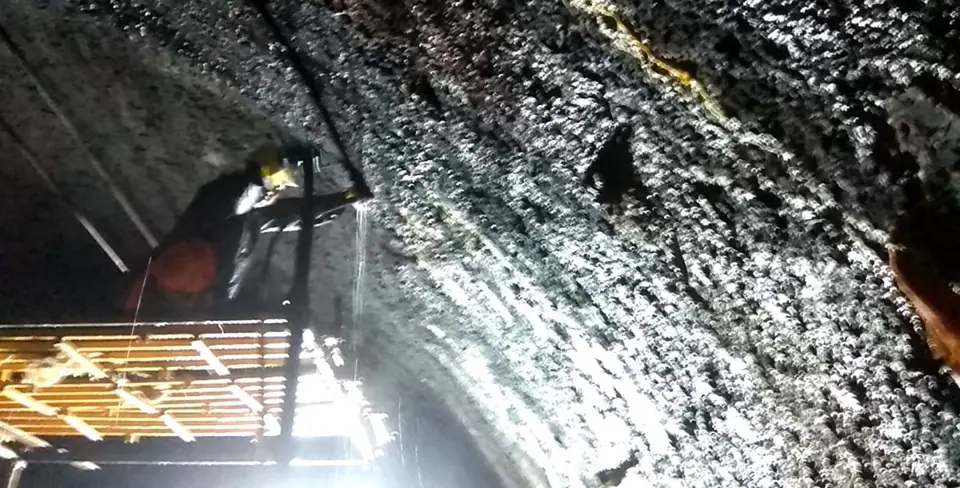
Parsik tunnel, Thane–Kalyan
Seepage controlled in a brick-lined railway tunnel built in 1916, on a busy main line, without stopping the trains.
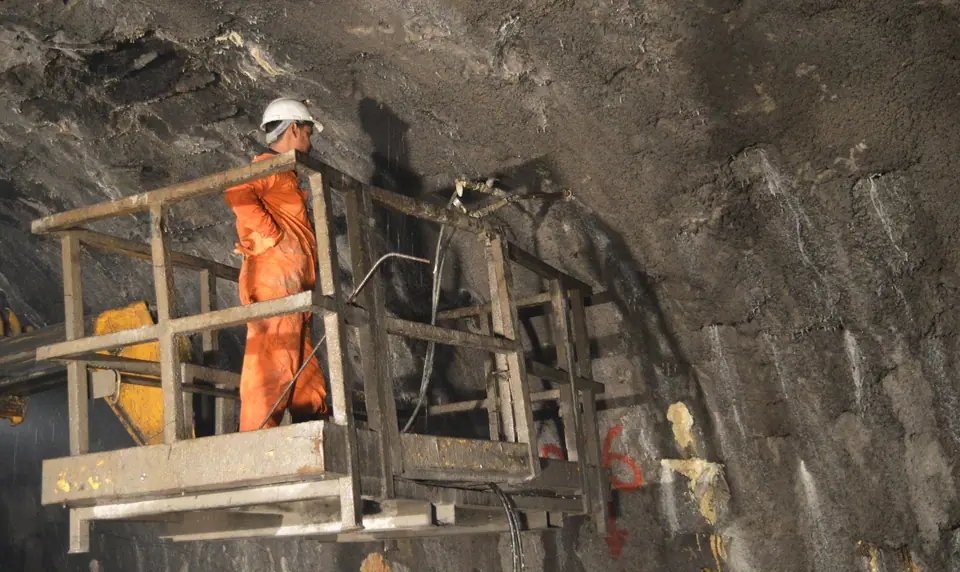
USBRL tunnels T-1, T-3 and T-5, Katra
Heavy water ingress in Himalayan tunnels, controlled with our resin, grout design and crews: recorded by Northern Railway at up to 2,500 litres per minute.
Questions
What clients ask
Can you work in a tunnel without closing it?
Yes, if the operator can give gaps between trains or night blocks. In the Parsik tunnel, on a busy main line, the work was done around live traffic, under the overhead line and without a ventilation duct.
Will injecting behind an old masonry lining damage it?
Not if the pressure is controlled. We monitor the lining while injecting and set the pressure from what the monitoring shows.
Related services
Often used together
Tunnel water ingress control
Leaks and inflow stopped in tunnels, shafts and underground structures.
Crack and joint injection
Leaking cracks and joints sealed, and structural cracks bonded, in concrete and masonry.
Rock bolting and self-drilling anchors
Rock bolts, self-drilling and prestressed anchors for tunnels, portals, slopes and caverns.
Waterproofing and polyurea linings
PU membranes and polyurea linings for decks, tanks, tunnels and water structures.
Seeing this on your site?
Send us what you see, where, and the access or traffic window. An engineer reviews it and replies with the next step.